
Trailer Music–The First Music Impression: Between Art And Commerce (Part 2)
It is known how to make a good trailer tune; it is also known that it is not a simple challenge. From the beginning of trailer-making, the practice of reusing music used for other trailers has flourished–after all, once an appropriate sound is found, it is tempting to use its qualities and maybe even the popularity it acquired through the movie that used it before. Classical music such as Carmina Burana or Lux Aeterna has been overused to the point it is hardly ever brought up anymore; so did pop songs like Walkin’ on Sunshine.

Disclaimer: The contents and opinions of this blog post do not represent the views or values of Honours Review as a publication.
Qualities of a Prototypical Trailer Theme
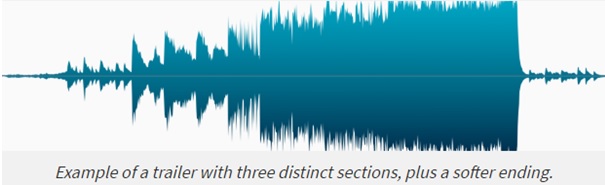
Source: Wright, Jonathan. “Tips for Composing Trailer Music”. Jonathan Wright Music, 2016. http://www.jonathanwrightmusic.com/composing-trailer-music/. Accessed: 03.06.2018.
Tips and masterclasses on trailer composing can be found online–choosing and creating music for film previews has grown multiple tendencies, preferred structures and even downright clichés seen in the statistics. A typical trailer released between 2014 and 2017 would contain a cover of a pop/rock song originally released in the 60s or 70s in a somber mood (7); since 2017 over six major trailers (Assassin’s Creed, Power Rangers, Atomic Blonde, etc.) featured a song by Kanye West (8); Suicide Squad and Guardians of the Galaxy proved that marketing of a movie can work mainly around the incorporation of popular music in the trailers. If the music is to be composed for the trailer, it will usually start with a brief intro presenting the theme, followed by a build-up, intense, blasting climax, a sudden full stop, and a quiet outro (9). Fanfares and huge orchestral arrangements (preferably with choirs) are perfect for the culmination. Slight changes in mood followed by a return to the main theme can be a good idea, as it can both provide variety and response at hearing the known tune repeated. In between, sound design effects will be included for the purpose of intensifying the cuts and action (boom, hit, drop, whoosh) or suspense (braam, riser, drone) (9). The purpose always kept in mind is to make an audience remember the trailer even a few days after they saw it: letting them recognize their favorite songs can be just as good of a strategy for it as creating an epic or deeply terrifying atmosphere.
Reuse–Advantage or Drawback?
It is known how to make a good trailer tune; it is also known that it is not a simple challenge. From the beginning of trailer-making, the practice of reusing music used for other trailers has flourished–after all, once an appropriate sound is found, it is tempting to use its qualities and maybe even the popularity it acquired through the movie that used it before. Classical music such as Carmina Burana or Lux Aeterna has been overused to the point it is hardly ever brought up anymore; so did pop songs like Walkin’ on Sunshine. When professional trailer music-making bands and composers saw the opportunity, they began to create albums full of music ready to use for trailers (once again, Two Steps from Hell is a perfect example), and soon enough their different musical pieces (already quite similar to each other sound-wise) became part of the canon of constantly reused trailer soundtracks.
On the one hand, not that many people watch enough movie trailers to be bothered by the trends of overuse. Most of the time, it is the visuals and reveal of the narrative present in the trailer that are discussed, rather than music (unless the sound is either exceptionally good or really bad). These tunes are not meant to be original–they are just supposed to hook the audience onto the action, intensify the visuals and leave a lasting first impression–and they are capable of doing exactly that even if it is their fifth or twentieth time of reuse. Trailer music, as instrumental or mood-driven can easily fit many narratives without seeming out of place. At the same time, though, critics and more knowledgeable audiences are increasingly bothered by the trends of utter commercialization of music in movie trailers. Since 2015 YouTube videos and general articles focused more on pointing out these practices of overuse. Eventually, the news has the potential to spread enough to reach even the less interested audiences who might have enjoyed trailers without noticing how cheap their music production is but now can become aware and critical. Recognizing music from another trailer in a new one can not only lead to the critique of commerce, but it can also remind the viewer of another trailer/franchise they heard the song in. This, in turn, can lead them to compare the two, which is a danger if the trailer for the new movie is not better than the old one (10).
Conclusion
Trailer music, like every other domain of art, has its clichés and commodified ideas on how to make a good first impression. However, unlike many art disciplines and unlike film music, it is far less bothered by it, due to the fact it lies in the domain of marketing. As a result, audiences who pay attention to the sound and value artistic qualities may have their hype for a movie damaged by the cheap production of trailer music. Others, however, stay unbothered–so if the marketing corporations manage to avoid overusing a song after it surpasses a point of its bad fame spreading, they can still practice reuse safely. At the end of the day, trailers are fleeting and it is the movie that matters far more; the previews and their music serve a mere pragmatic function, which can be executed more easily when known successful structures are used.
Bibliography:
Trailer Park. “About”. Trailer Park Official Website, 2018. https://www.trailerpark.com/about. Accessed: 3 June 2018.
Kelly, Stephen. “Movie trailer music: it's not what you think”. The Guardian, 2011. https://www.theguardian.com/film/2011/aug/25/movie-trailer-music. Accessed: 3 June 2018.
Ward, Caleb. “How to Pick the Right Tone, Shots, and Music for Trailers”. The Beat, 2015. https://www.premiumbeat.com/blog/how-to-pick-the-right-tone-shots-and-music-for-trailers/. Accessed: 3 June 2018.
John Beal. “Credits”. Composer John Beal, 2018. http://composerjohnbeal.com/credits/. Accessed: 3 June 2018.
Barrera, Sandra. “Trailer score heroes: Two Steps from Hell brings its epic orchestra scores to the Walt Disney Concert Hall”. Daily News, 2013. https://www.dailynews.com/2013/06/07/trailer-score-heroes-two-steps-from-hell-brings-its-epic-orchestra-scores-to-the-walt-disney-concert-hall/. Accessed: 3 June 2018.
Boltanski Luc andThévenot, Laurent.On Justification: Economies of Worth.Translated by: Catherine Porter. Princeton University Press, 2006.
Gruttadaro, Andrew. “How to Choose the Right Cover Song for a Movie Trailer”. The Ringer, 2017. https://www.theringer.com/2017/7/27/16078190/how-to-choose-the-right-cover-song-for-a-movie-trailer-f1674c5011c4. Accessed: 3 June 2018.
Heritage, Stuart. “Harder? Better? Faster? Stronger? Why is every trailer soundtracked by Kanye?” The Guardian, 2017. https://www.theguardian.com/music/2017/may/26/kanye-west-trailer-soundtracks-netflix-ozark. Accessed: 3 June 2018.
Yajima, Austin K. “Trailer Music Terminology: Explained Easy!” Trailer Music Academy, 2017. https://www.trailermusicacademy.com/trailer-music-terminology-explained-easy/. Accessed: 3 June 2018.
DanFanMac. “Overused Trailer Music: 4 Reasons You Should Never Use a Song More Than Once”. Fuzzy Elevator Trailer House, 2015. https://fuzzyelevatortrailerhouse.wordpress.com/2015/08/14/overused-trailer-music-4-reasons-you-should-never-use-a-song-more-then-once/. Accessed: 3 June 2018.
Trailer Music–The First Music Impression: Between Art and Commerce (Part 1)
First impressions are crucial. Whenever a movie is to be released, trailers are needed to promote it at least 6 months in advance. Most of the time, this moment is what determines whether the movie becomes a hit or a smash, whether the audience will be swept away by the promised greatness, fun or fear (depending on the movie genre) or will be disappointed already by the sneak peek.

Disclaimer: The contents and opinions of this blog post do not represent the views or values of Honours Review as a publication.
The Role of Trailer Music
First impressions are crucial. Whenever a movie is to be released, trailers are needed to promote it at least 6 months in advance. Most of the time, this moment is what determines whether the movie becomes a hit or a smash, whether the audience will be swept away by the promised greatness, fun or fear (depending on the movie genre) or will be disappointed already by the sneak peek. Regardless of the result, the first impression is always reflected in box office takings, which is why trailer-making is often delegated to professional marketing companies such as Trailer Park (1).
Although the creation of trailers takes place when enough scenes are already finished to be cut into a coherent preview, the movie soundtracks are usually not yet available (2). Music, however, is no less important than visuals to create a lasting impression. As a result, the careful selection of the trailer sound matters to the producers, although different movies choose different approaches towards it: new or recycled composition, obscure or overused track. Nowadays, a vast majority of trailer music remains fairly conventional, and trailer music choices are full of clichés, repetitions and overuses–that clash of art and commerce generates an increasing backlash as an antithesis of artistic. In spite of that, the current trailer-making system still functions well and thriving in its function of bringing the audiences to the cinema. But how exactly is trailer music being made and why is it all so similar?
How Is Trailer Music Selected?
Essentially, trailers are simply advertisements made by companies specialized in marketing rather than film-making. An effect of prioritizing commerce is visible already in the production process.
The preview creators have a multiplicity of options to choose from when it comes to the place where they search for the most suitable music. A major concern and limitation, however, is that the music has to be royalty-free (3) (available to use without the need to pay royalties or license fees), unless the movie budget allows for additional copyright expenses. Effectively, popular choices for trailer music come from: classical music, popular songs (and their covers), other music scores from different trailers by the same producer (for example, Tim Burton’s Corpse Bride used parts of The Nightmare Before Christmas soundtrack in the trailer), and tunes by composers and bands specialized in trailer-music making (such as John Beal (Titanic, Star Wars, The Matrix, etc.)) (4), and the very popular Two Steps from Hell (Star Trek, Harry Potter and the Deathly Hallows: Part 2 (5)). In the recent years, an observable tendency is a switch away from commissioning original pieces for trailers, toward music that is known to have worked for other movies (2).
This music is chosen with the film narrative and mood kept in mind: horror trailers look for music generating suspense, action cinema always incorporates sounds described as ‘epic’ or ‘badass’, and romantic comedies choose upbeat popular pop songs. While some editors prefer to cut the scenes to an epic trailer music they find, a better strategy is to first choose a trailer’s visuals and edit music later (3)–music, after all, has a secondary role. Typically, the chosen tunes last around two minutes, but have a fully developed structure; they are a “heavily briefed, tightly wound and meticulously edited piece of work in which every second counts” which is quite a challenge to achieve (2). Even if an already-existing song or classical piece is chosen, it is usually heavily edited before it gets incorporated in a trailer, as sound design effects need to be added and the music has to match the visuals. On the other hand, original trailer score producers more and more often hear demands for composing a piece “as big a sound as possible and just like something that somebody else did but different enough to not get us sued” (2). Originality and Inspired World values (uniqueness and artistic quality) are only of importance if they serve the Market World (profit maximization, as described by Boltanski & Thevenot) (6): attracting audiences through the greatness or popularity of the tune, while at the same time avoiding possible suing.
Bibliography:
Trailer Park. “About”. Trailer Park Official Website, 2018. https://www.trailerpark.com/about. Accessed: 3 June 2018.
Kelly, Stephen. “Movie trailer music: it's not what you think”. The Guardian, 2011. https://www.theguardian.com/film/2011/aug/25/movie-trailer-music. Accessed: 3 June 2018.
Ward, Caleb. “How to Pick the Right Tone, Shots, and Music for Trailers”. The Beat, 2015. https://www.premiumbeat.com/blog/how-to-pick-the-right-tone-shots-and-music-for-trailers/. Accessed: 3 June 2018.
John Beal. “Credits”. Composer John Beal, 2018.http://composerjohnbeal.com/credits/. Accessed: 3 June 2018.
Barrera, Sandra. “Trailer score heroes: Two Steps from Hell brings its epic orchestra scores to the Walt Disney Concert Hall”. Daily News, 2013. https://www.dailynews.com/2013/06/07/trailer-score-heroes-two-steps-from-hell-brings-its-epic-orchestra-scores-to-the-walt-disney-concert-hall/. Accessed: 3 June 2018.
Boltanski Luc andThévenot, Laurent.On Justification: Economies of Worth.Translated by: Catherine Porter. Princeton University Press, 2006.
Gruttadaro, Andrew. “How to Choose the Right Cover Song for a Movie Trailer”. The Ringer, 2017. https://www.theringer.com/2017/7/27/16078190/how-to-choose-the-right-cover-song-for-a-movie-trailer-f1674c5011c4. Accessed: 3 June 2018.
Heritage, Stuart. “Harder? Better? Faster? Stronger? Why is every trailer soundtracked by Kanye?” The Guardian, 2017. https://www.theguardian.com/music/2017/may/26/kanye-west-trailer-soundtracks-netflix-ozark. Accessed: 3 June 2018.
Yajima, Austin K. “Trailer Music Terminology: Explained Easy!” Trailer Music Academy, 2017. https://www.trailermusicacademy.com/trailer-music-terminology-explained-easy/. Accessed: 3 June 2018.
DanFanMac. “Overused Trailer Music: 4 Reasons You Should Never Use a Song More Than Once”. Fuzzy Elevator Trailer House, 2015. https://fuzzyelevatortrailerhouse.wordpress.com/2015/08/14/overused-trailer-music-4-reasons-you-should-never-use-a-song-more-then-once/. Accessed: 3 June 2018.