

Jazz in the USSR: Freedom, Popular Culture, and ‘the Decadent West’
Feeling a bit jazzy today? Not in the Communist Party of the Soviet Union.
The USSR and jazz had a love-hate relationship ever since the country’s formation in the early 1920s: the officials hated it, the youth loved it.
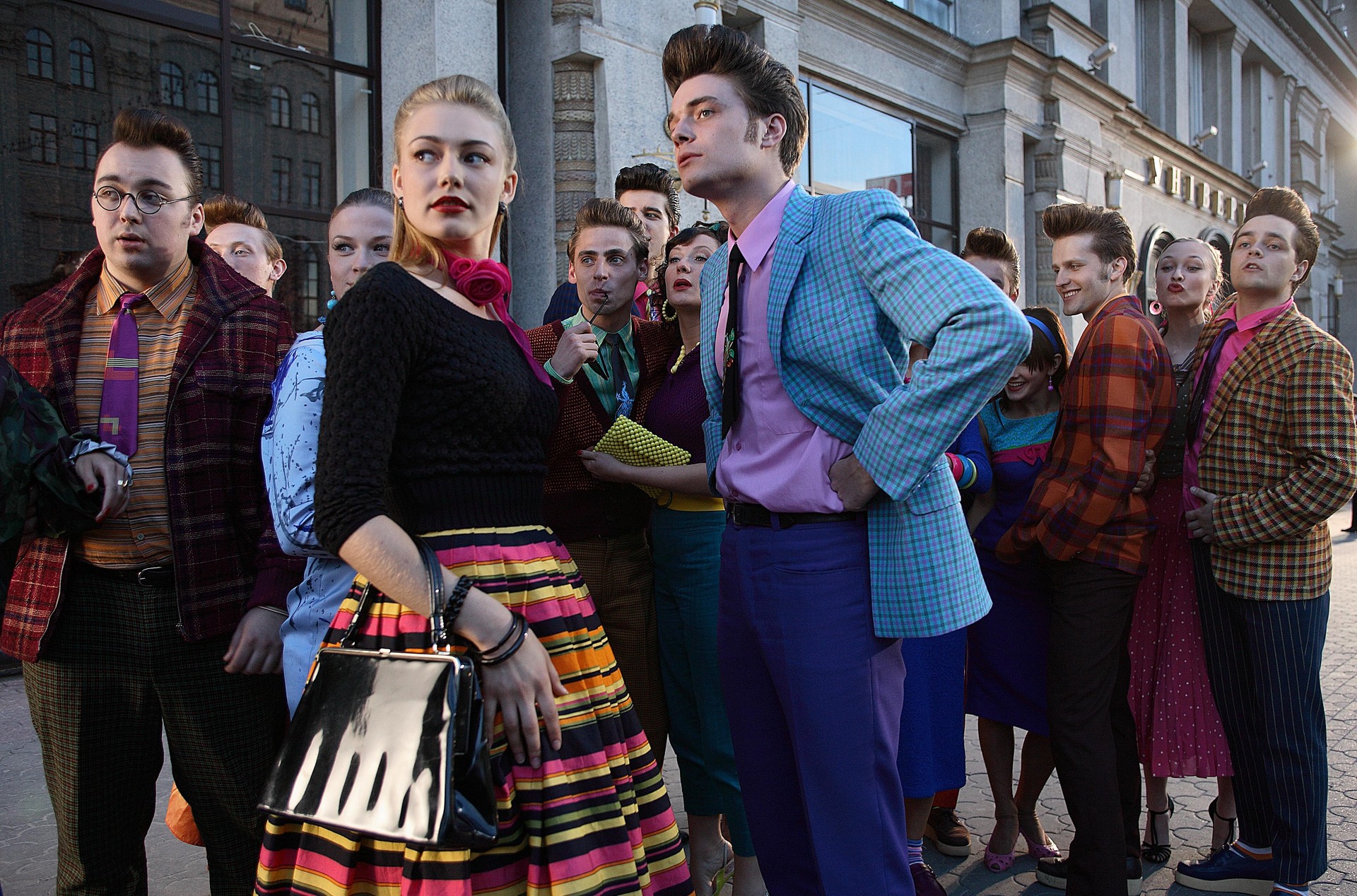
Still from Valery Todorovsky’s 2008 musical Stilyagi. Image source: http://popkult.org/hipsters/.
Disclaimer: The contents and opinions of this blog post do not represent the views or values of Honours Review as a publication.
Feeling a bit jazzy today? Not in the Communist Party of the Soviet Union.
The USSR and jazz had a love-hate relationship ever since the country’s formation in the early 1920s. To give an example, during his fruitful career, Russian composer and pianist Dmitri Shostakovich wrote three ballets: The Golden Age, op. 22 (1929-30), The Bolt, op. 27 (1931), and The Bright Stream, op. 39 (1935). The Bolt follows the story of Lazy Lyonka, a worker in a Soviet factory, who, together with an anti-Soviet plotter, decides to sabotage the factory’s machinery by putting a bolt into it. Their plan, however, is quickly foiled by Komsomol, a political youth organization of the USSR. Soon after premiering on April 8, 1931, The Bolt was banned: Lyonka’s “languid waltz” and the ballet’s tango and jazz-inspired tunes were a bit too ‘Western’ for the Soviet cultural elites to handle (1).
But what exactly was it about jazz that made its reputation so unfavorable in the eyes of the Soviet officials? There are a few reasons: from the Soviet Union’s official aesthetic doctrine, Socialist Realism, to jazz’s close association with freedom, underground Soviet pop-culture, and decadence.
Socialist Realism: Narodnost, Partiinost, Ideinost!
Socialist Realism became the official aesthetic doctrine of the Soviet Union in 1932. Its emergence was detrimental to the Soviet artistic sector and its freedom of expression. The essence of Socialist Realism can be summed up in the following three principles: ideinost, narodnost, and partiinost (3). The first, ideinost, meant promoting socialism in artistic productions. Narodnost required works of art to represent the national character of the Soviet Union. Finally, partiinost demanded authors and their productions to express loyalty to the Communist Party (3). Apart from these three principles, works of art that were considered suitable for the popular masses had to celebrate the various cultures of the Soviet Union (and there were quite a few), “speak to the everyday life of the masses”, and inspire Soviet workers with optimism about ‘the bright future’ of the communist project (3).
With these aesthetic requirements in action, little room was left for creative freedom and expression. Jazz, in particular, suffered from ideological oppression in the 1930s and the 1940s during the so-called “anti-cosmopolitanism” campaign. During this campaign, it was difficult, if not impossible, to talk about foreign influence on Soviet culture: “writers, artists, scholars, and scientists were attacked for any sign of foreign influences on their work or for studying ties between Russian and foreign cultural figures” (4). Amidst such a political and cultural climate, jazz-style pieces were seen by the authorities and the cultural elites as laden with foreign, American influence, and thus potentially harmful for the Soviet youth (5).
The genre as a whole either remained at the margins of the Soviet artistic scene or went underground. Those who were really enthusiastic about jazz “adopted illegal methods to access the newest foreign jazz pieces and information on jazz” from other members of the jazz fan community or the black market (5). In a propaganda department report on Moscow youth in 1952, Komsomol complained that “vulgar western fox-trots and tangoes” are completely pushing out “beautiful Russian musical ball dances” from state-sponsored popular culture (5). Valery Todorovsky’s 2008 musical Stilyagi, which follows the development of the Soviet youth counter-culture of the same name, visually brings us into the midst of the dynamic atmosphere of the “anti-cosmopolitanism” campaign. It was only after Stalin’s death in 1953, de-Stalinization, and the lessening of top-down artistic oppression, that jazz experienced a revival, with grassroots club activities and youth cafés dedicated to jazz and its fans opening around Moscow and Saint Petersburg (5).
“Jazz Means Freedom”
In the eyes of the Soviet officials, not only was jazz exposing the Soviet youth to influences of the West and could potentially inspire it to acquire a decadent, bourgeoise American lifestyle, but the expressive jazz and swing tunes could also motivate, they thought, jazz enthusiasts to rebel against the elites.
In his acceptance speech for the Spingarn Award by NAACP in 1959, awarded for outstanding achievements by an African American, Duke Ellington, American pianist, composer and leader of a jazz orchestra, when asked “why” American jazz “was so much in vogue in other countries”, replied, “I thought the reason was that jazz means freedom” (1). For the Soviet youth, especially, this freedom could mean freedom from communism or even “freedom from Moscow”, as was the case for the Baltic states where many considered jazz as sign of rebellion against ‘conservative Moscow’ (1). Jazz, in this sense, represented “both the freedom of expression and the spirit of rebellion against authority, that the Soviet youth so fervently sought to emulate” (1).
And Freedom Means Jazz
To wrap up, although the Soviet officials were never really happy with jazz even as early as Shostakovich started incorporating jazz tunes into his ballets, the genre provoked tremendous enthusiasm among generations of Soviet youths. For the elites, jazz symbolized the decadent, bourgeois West, while, in contrast, it allowed the Soviet youth to come in touch with the American cultural scene, and symbolically enjoy a degree of freedom. Even during the most intense period of top-down cultural oppression during the 1930s and the 1940s, jazz enthusiasts managed to get their hands on the latest records through more or less (il)legal ways. Their case demonstrates the energy with which the Soviet youth exercised its own freedom in the underground cultural scene and the various jazz clubs and cafés in Moscow and Saint Petersburg, despite the suffocating political atmosphere outside of their jazz-bubble. As such, we can slightly rephrase Ellington’s statement that “jazz means freedom” into “freedom means jazz”—for the Soviet youth, it created a space in which they can escape the monotonous Soviet reality, even if only for a little while.
Sources:
1. Davenport, Lisa E. Jazz Diplomacy: Promoting America in the Cold War Era. Jackson: University Press of Mississippi, 2009.
2. Ilichova, Marina. “Shostakovich’s Ballets.” The Cambridge Companion to Shostakovich. Eds. Pauline Fairclough and David Fanning. Cambridge: Cambridge University Press, 2008.
3. Kaganovsky, Lilya. “Stalinist Cinema 1928-1953.” The Russian Cinema Reader: Volume I, 1908 to the Stalin Era. Ed. Salys Rimgaila. Boston: Academic Studies Press, 2013. 208-234.
4. Tolz, Vera. Russia: Inventing the Nation. New York: Oxford University Press, 2001.
5. Tsipursky, Gleb. Socialist Fun: Youth, Consumption, and State-Sponsored Popular Culture in the Soviet Union, 1945-1970. University of Pittsburgh Press, 2016. .
‘Reinventing the Wheel’: How the Current Anime and Manga Scene Is Drawing Its Inspiration from the Theme of ‘the Doppelgänger’
Anyone who has ever read Sui Ishida’s popular dark fantasy manga series Tokyo Ghoul or watched at least one episode of its anime adaptation probably noticed that the series largely builds its plot around the theme of the so-called ‘(evil) double’ or ‘the Doppelgänger’.
Disclaimer: The contents and opinions of this blog post do not represent the views or values of Honours Review as a publication.
Anyone who has ever read Sui Ishida’s popular dark fantasy manga series Tokyo Ghoul, or watched at least one episode of its anime adaptation, probably noticed how the series largely builds its plot around the theme of the so-called ‘(evil) double’ or ‘the Doppelgänger’.
Tokyo Ghoul is set in an alternate reality where humans coexist with cannibalistic ghouls. The ghouls look exactly like ‘normal’ human beings as well as mimic their behavior and appearance. Most of them live among the human population in secret to avoid being caught by the authorities. Some of them, however, are consciously trying to suppress their ‘ghoulish’ nature, integrate with the human population, and pursue a ‘normal’, human life.
Throughout the greater part of the series, the protagonist Kaneki Ken struggles with his ‘inner-ghoul’ and tries to find a balance between his human and ghoul side. Kaneki’s struggle, however, is a bit more intense than that of an ‘every-day ghoul’ because Kaneki is a half-ghoul; neither a complete ghoul, nor a complete human being. A half-ghoul is usually an offspring of a human and a ghoul or is created artificially by transplanting ghoul organs into a human, as was the case with Kaneki.
As a half-ghoul, Kaneki experiences double-alienation; both from the world of ‘pure’ human beings and the world of ‘pure’ ghouls, due to which his character development primarily revolves around balancing the ‘human Kaneki’ and the ‘ghoul Kaneki’, as well as finding a way for humans and ghouls to coexist. The whole concept of the inner coexistence between the ‘human Kaneki’ and the ‘ghoul Kaneki’, together with the character’s attempts to suppress his ‘ghoulish’ nature at the beginning of the series, is also reflected in the first seasons’ opening theme Unravel by Toru Kitajima from Ling Tosite Sigure and its lyrics: “Is there someone inside of me?”
In Ishida’s world, the figure of the ghoul can be seen as a metaphor of duality and the darker side of human nature. The ghoul metaphorically channels suppressed desires and/or uncontrollable feelings. So, for instance, while ‘human Kaneki’ would not even dare to hurt a fly, the ‘ghoul Kaneki’ channels precisely those aspects of Kaneki’s character which largely remain suppressed or hidden in his ‘human side’, such as Kaneki’s eventual decision to ‘hurt’ (i.e., completely smash) other ghouls in order to protect the people he cares for. But this dynamic between the two sides of Kaneki’s character and the idea of suppressing some uncontrollable aspects of human nature is not really that new in contemporary Japanese popular culture.
In general, the theme of the “Doppelgänger” (German: Literally “double-goer”) actually goes all the way back to German Romanticism and the German poet Heinrich Heine. Heine’s poem Der Doppelgänger (1828) introduces the figure of ‘the double’ through the image of a man who suffers a mental breakdown once he encounters an individual looking uncannily like him.
Even though the theme of the “Doppelgänger” has roots in German Romanticism, it has become better known through the works of Edgar Allan Poe, Robert Louise Stevenson, and the Russian writer Fyodor Mikhailovich Dostoevsky. Poe’s short story William Wilson (1839) revolves around a student who meets a boy of the same name, age, and appearance. As a result, he loses his mind as the story unfolds and ‘the other William Wilson’ keeps appearing at different stages of ‘the original William Wilson’s’ life. Stevenson’s Strange Case of Dr. Jekyll and Mr. Hyde (1886) is probably the most famous story dealing with the theme of ‘the double’, in which Dr. Henry Jekyll experiments with chemicals that eventually turn him into the devious Mr. Edward Hyde. Finally, Dostoevsky’s famous novel The Double (1846) tells the story of a mentally-unstable clerk who is convinced that a double is stealing away his job, girl, and eventually bedroom. There’s a bunch of other books dealing with the theme of ‘the double’, but these are probably some of the best-known examples. There’s also a ton of pretty interesting movie adaptations to check out, such as Richard Ayoade’s The Double (2013), focusing on Dostoevsky’s novel.
The theme of ‘the double’ is also flooding the contemporary anime and manga scene and many popular series and productions are arguably inspired by the same themes that intrigued the minds of Poe and Stevenson almost a century ago. Tokyo Ghoul is just one of them. Recent volumes of Yana Toboso’s manga series Black Butler, for example, have revealed that the young Earl Ciel Phantomhive actually has a twin brother (as if one spoiled English lord was not enough for Sebastian to handle).
Although dealing with the theme of ‘the double’ in a different way, Hajime Isayama’s Attack on Titan is similar to Tokyo Ghoul in some of its underlying ideas. For instance, while in Ishida’s story world the ghouls turn into a metaphor of some darker aspects of human nature, the same can be said for the humanoid giants in Isayama’s. Attack on Titan’s protagonist Eren Yaeger also goes through similar struggles as Kaneki while trying to control the transformations into his titan form. The figure of the titans, and the idea of humans transforming into them, can also be read as a metaphor of uncontrollable or inhuman urges that are sometimes difficult to suppress or should, for better or for worse, perhaps remain hidden.
The same goes for Ichigo Kurosaki from Tite Kubo’s manga and anime series Bleach. In Bleach, the theme of ‘the double’ is represented through Ichigo’s struggles with his hollow side (in the fictional world of Bleach, hollows are corrupted spirits which devour the souls of human beings), and many episodes of the anime and manga are visually impressive in their way of depicting how the human in Ichigo is gradually being devoured by the hollow inside him.
The list of anime series inspired by the theme of ‘the double’ could go on into infinity, but I will wrap up with one last example: Kazue Kato’s Blue Exorcist. This one is perhaps not the most obvious example but we can read Rin Okamura’s initial urge to suppress his demon instincts as representing a struggle between his ‘human self’ and the ‘demonic other’.
All in all, it is interesting to see how many anime and manga series are actually inspired by similar themes. From Tokyo Ghoul to Attack on Titan and Blue Exorcist, some elements in all of these series can be seen as based on the concept of ‘the Doppelgänger’ or ‘the (evil) double’. The frequent occurrence of the motif of ‘the double’ and the protagonist’s inner struggle to balance different aspects of his/her personality attests to these themes’ recurrent presence in contemporary Japanese popular culture, even though they have roots in German Romanticism and Edgar Allan Poe, or probably even further back in history. In any case, one could easily say that the series discussed above are just ‘reinventing the wheel’, but they all are still pretty amazing and give a ‘centuries-old theme’ their own, unique twist.