

Fragility, Pride, and Historical Legacies in Isao Takahata's "Grave of the Fireflies" (1988)
Directed and produced by Isao Takahata, Grave of the Fireflies (1988) is an animated movie telling a story of war, grief, and tragedy. During an attack on their village two children, Seita and Setsuko lose their mother. Their father is a soldier in the Japanese army, currently fighting in the Second World War, so the children decide to temporarily stay with their aunt. However, as time passes, the aunt begins to treat Seita and Setsuko as if they are unwanted intruders in her household. As a result of their relative's attitude and lack of compassion, the children proceed to run away and move in an abandoned bunker which they try to transform into a home. As the story unfolds, it portrays Seita and Setsuko's experiences while dealing with post-war reality – hunger, illnesses, and loneliness.
Disclaimer: The contents and opinions of this blog post do not represent the views or values of Honours Review as a publication.
Directed and produced by Isao Takahata, Grave of the Fireflies (1988) is an animated movie telling a story of war, grief, and tragedy. During an attack on their village two children, Seita and Setsuko lose their mother. Their father is a soldier in the Japanese army, currently fighting in the Second World War, so the children decide to temporarily stay with their aunt. However, as time passes, the aunt begins to treat Seita and Setsuko as if they are unwanted intruders in her household. As a result of their relative's attitude and lack of compassion, the children proceed to run away and move in an abandoned bunker which they try to transform into a home. As the story unfolds, it portrays Seita and Setsuko's experiences while dealing with post-war reality – hunger, illnesses, and loneliness.
Many analyses focus solely on the literal historical aspects of Takahata’s film, however, I believe that for a substantial reading of the story it is crucial to consider the symbolism incorporated into it. Multiple elements included in the movie carry figurative meanings that ought to be acknowledged in order to precisely grasp the essence of the movie. For the purposes of this text, I have selected three notably prominent motives: the notion of fragility, patriotism and historical legacies, and the motive of pride. Nevertheless, it is necessary to also include a disclaimer at this point in the text – this paper is written with complete awareness that the film features multiple more distinct themes that could potentially alter interpretations discussed in further parts of the text.
Fragility
The notion of fragility is one of the most pronounced themes present in Takahata’s Grave of the Fireflies, and the title itself is already a suggestion of possible interpretations and readings. As stated by Mario Vargas Llosa, “though we virtually take it for granted, the title (...) is often one of the first clues to the quality and direction of the reader’s conceptual involvement and properly should be considered integral to the frame of the work.”. Although in this statement Llosa is referring to titles of novels, I find it equally applicable in the field of film analysis. In the case of Takahata’s movie, overlooking the meaning of the title and its implications for the analysis would most likely result in degradation of the whole interpretation. To further explore this notion in a clear manner, it is vital to provide a brief explanation of the plot of fragments of Grave of the Fireflies. At the very beginning of the movie, two main characters are introduced. Seita and Setsuko, or rather their ghosts, come out of a can that is laying next to Seita’s body. They are accompanied by a swarm of fireflies. Multiple times throughout the movie, the fireflies are described as beautiful but fragile creatures; they are one of the very few beautiful things in Seita and Setsuko’s life which mostly consists of trying to escape the war and its consequences. Following this thought, as well as taking into consideration the plot of the whole movie, one can assume that the titular fireflies refer to the main characters and their struggles in Japan torn by war. Similarly to the insects, the children are fragile and cannot endure the difficulties that they have to face in their everyday fight for survival. They metaphorically light up with appropriate for their age optimism and hope for the future, and they try to fend for themselves; however, it does not last long, as the lifespan of a firefly is very short. Alike the literal light of a firefly, the figurative light glows in the children intensely yet briefly - the reality breaks Seita and Setsuko’s spirits and it weakens them physically. At some point in the movie, Setsuko asks her brother “Why do fireflies have to die so soon?” but her question is left without an answer.
Pride
Although it is not as prominently and obviously its component as the notion fragility, another important element in Grave of the Fireflies that is significant for a clear understanding of the movie is the concept of pride. This particular notion is present in various forms within the movie. First of all, pride is a sort of a catalyst for Seita to take care of his sister by himself after their mother died. Their father is in the army and Seita gets into an argument with a relative they stay with for a short time so the children end up homeless and on their own. As an older brother’s duty, Seita has to protect and take care of his little sister. He genuinely does his best to find shelter and get food for himself and Setsuko. In his efforts, he even starts stealing and he gets badly beaten up, though in front of his little sister he puts on a mask and convinces her that everything is fine. However, as time goes by and Seita does not succeed in providing food enough for both of them, Setsuko becomes malnourished and sick, and as a result, she passes away. As much as Seita tried to take care of his sister, it was his pride that firstly became the reason why they left their relative’s house. It was also pride that stopped the boy from getting real help when Setsuko got sick; instead, he claimed that as the older brother who should be able to look after his younger sibling he had the situation under control. Nevertheless, it is not clear if Seita really believed so, or it was only wishful thinking that he maintained as a coping mechanism to deal with the position the children were unable to escape.
Historical legacies
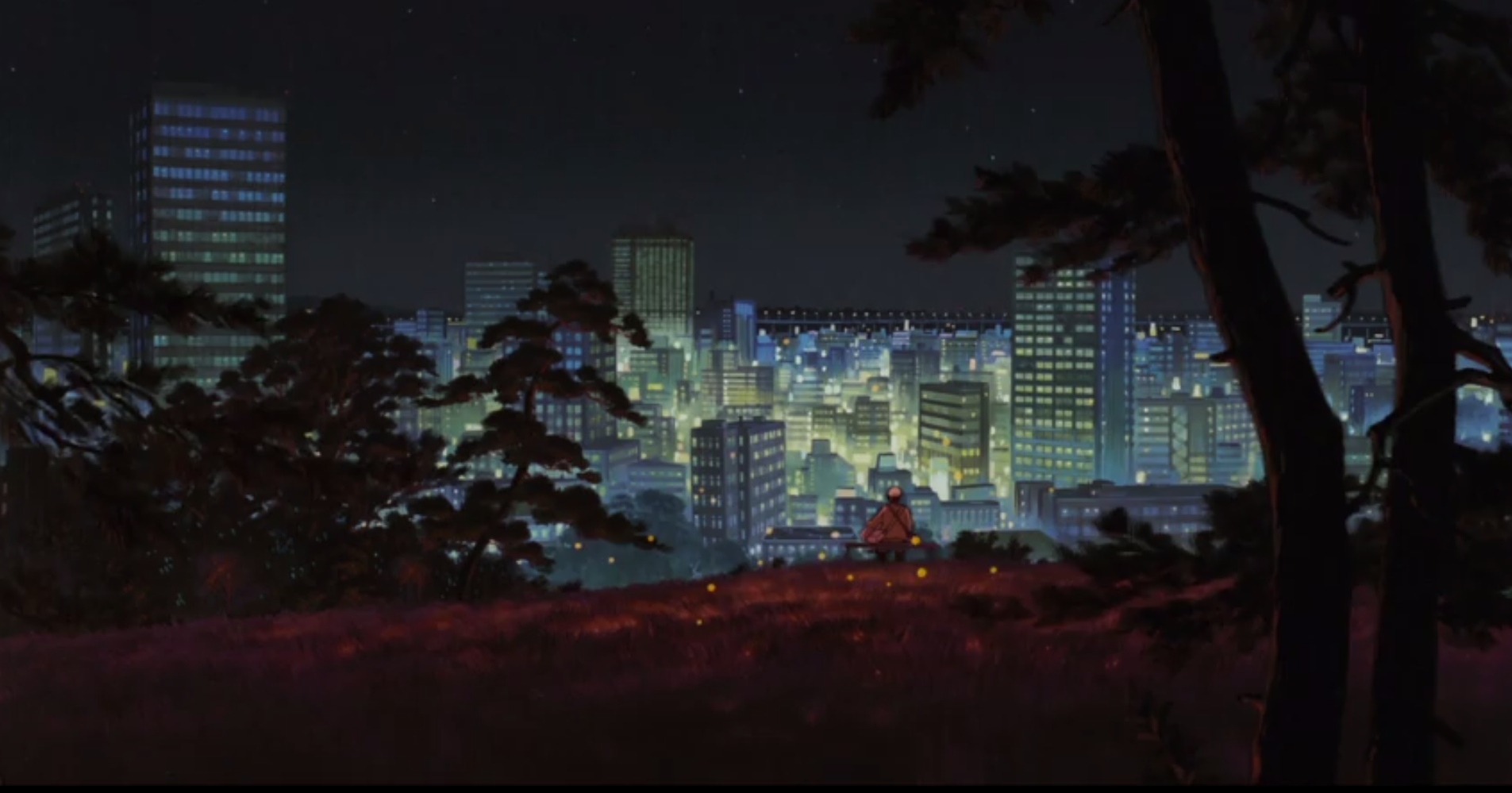
The ending scene of Grave of the Fireflies presents the third theme mentioned in the introduction which is the notion of historical legacies. Since the movie is inspired by real events that took place during the Second World War, the themes of patriotism, obligations to the state and to the society, fight for the common good, etc. are very present throughout the whole movie. However, for the sake of this article would like to focus on the ending sequence and its meaning in terms of the notion of historical legacies. In the last shot of the film, Seita and Setsuko’s ghosts can be seen peacefully sitting together on a bench on top of a hill. So far the story took place in what looked like a rather rural area of Japan - mostly small villages and fields. In this case, the setting seems to have changed quite profoundly. As Seita and Setsuko look down from the hill, the landscape on the other side appears in front of them. However, instead of seeing simple countryside scenery, it is a large city that emerges before the siblings. I find this particular scene especially relevant in the discussion about historical remembrance. The urban landscape rises on top of buildings destroyed by war, both literally and figuratively. It signifies the need to keep in mind the historical foundations that contemporary Japan is built on, but this message does not apply only to Japan. It can be seen as a suggestion for all viewers who grew up in countries that experienced military conflicts in the past to remember and respect the history of their countries because in many cases it was the ancestors’ fight for freedom, their resistance, and sacrifices that allowed for the construction of a stronger society. However, at the same time, it is also a reminder that many innocent people such as children like Setsuko and Seita lost their lives, which is undeniably a significant element of the notion of historical legacies.
Final thoughts
Being a depiction of a tragic story of two children trying to survive in a country torn by war, Isao Takahata’s Grave of the Fireflies is an example of a movie that portrays the notions of fragility, pride, and historical legacies as universal themes. Although this article offers multiple starting points for discussions regarding these topics, the three aforementioned motives are only some of many more possible perspectives that can be considered while interpreting this movie. I believe that it is crucial not only to take into account literal meanings of the symbolic elements incorporated in the movie, but also to consider their figurative, more universal significance of the components examined in this text.
References
Rossman, Charles, and Alan Friedman. Mario Vargas Llosa: A Collection of Critical Essays. University of Texas Press, 1978.
Takahata, Isao. Grave of the Fireflies. Studio Ghibli, 1988.
Additional materials:
Interview with Isao Takahata: https://www.youtube.com/watch?v=uRl0sjwx5Ac.
A short story by Akuyuki Nosaka: Nosaka, Akiyuki. "A Grave of Fireflies." Japan Quarterly 25.4 (1978): 445.
Bungo Stray Dogs: A Crash Course in World Literature
Scott Fitzgerald’s The Great Gatsby (1925). Or maybe Fitzgerald isn’t really your thing, but you simply can’t get enough of E. A. Poe’s short stories.
Now, how would you react if Jay Gatsby suddenly started walking down the streets of Yokohama and, or wait, let me rephrase this. How would you react if Jay Gatsby suddenly started flying above the streets of Yokohama in Moby Dick with Herman Melville, E. A. Poe and Mark Twain aboard, while H.P. Lovecraft is wading in the Tsurumi river below them, after having transformed into a giant, humanoid octopus?
Well, these are all pretty mainstream events in Bungo Stray Dogs.
Disclaimer: The contents and opinions of this blog post do not represent the views or values of Honours Review as a publication.
All right, let’s say you’re an avid reader and love F. Scott Fitzgerald’s The Great Gatsby (1925). Or maybe Fitzgerald isn’t really your thing, but you simply can’t get enough of E. A. Poe’s short stories.
Now, how would you react if Jay Gatsby suddenly started walking down the streets of Yokohama and, or wait, let me rephrase this. How would you react if Jay Gatsby suddenly started flying above the streets of Yokohama in Moby Dick with Herman Melville, E. A. Poe, and Mark Twain aboard, while H.P. Lovecraft is wading in the Tsurumi river below them, after having transformed into a giant, humanoid octopus?
Well, these are all pretty mainstream events in Bungo Stray Dogs.
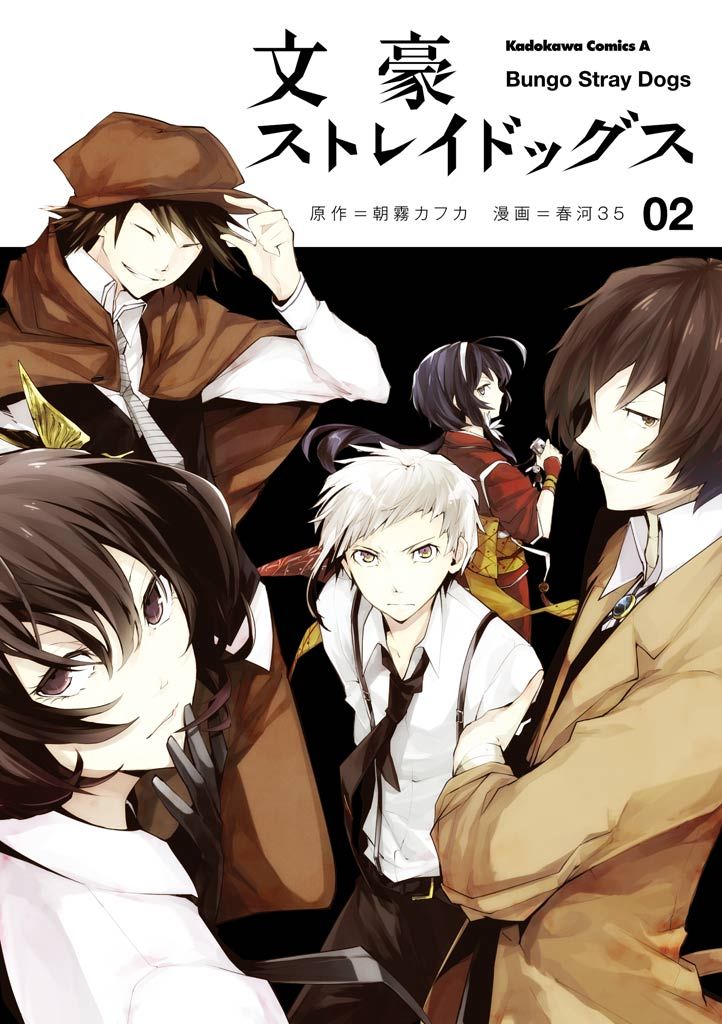
Cover of Bungo Stray Dogs volume two.
Bones studio’s Bungo Stray Dogs (lit. Literary Stray Dogs), a popular Japanese anime series which originally started airing in 2016, is making a big comeback with its third season this April (1). The otaku fandom is naturally excited; it has been almost a year since the series’ last movie adaptation, Bungo Stray Dogs: Dead Apple (2018), was released, and the adaptation, by introducing a bunch of new characters, excellent villains, and a fairly complex plot, only left us with much more questions than it answered.
Bungo Stray Dogs is based on the supernatural action manga of the same name that follows a group of skilled agents gifted with supernatural powers which they use to solve mysteries, fight Yokohama’s underground mafia, and occasionally blast a building or two into the sky.
But apart from the crowd that is regularly engaged with Japanese animation, Bungo Stray Dogs has a lot to offer to audiences that are not that well versed in Japanese anime and manga culture. Above all, it offers them a crash course in Japanese, American, and Russian literature.
Written by Kafka Asagiri and illustrated by Sango Harukawa for Young Ace magazine in 2012 (1), Bungo Stray Dogs is probably best known for basing its characters on famous writers and their books, such as Osamu Dazai, Ryunosuke Akutagawa, E. A. Poe, F. Scott Fitzgerald, and F. M. Dostoevsky. While each Bungo character represents a particular writer, their supernatural power is in one way or another connected to that writer’s works.
This way, for instance, Bungo Stray Dogs’ Osamu Dazai (all characters are actually called the same way as the writer they’re were based on), one of the series’ central figures, was inspired by the early 20th-century Japanese writer Osamu Dazai, author of The Setting Sun (1947) and No Longer Human (1948). The writer had a short but turbulent life: he lived during the two world wars, experienced a series of more or less serious diseases, wrote a number of novels and short stories whose popularity quickly turned him into a celebrity and attracted a secret admirer, regularly enjoyed way more sake than is advisable, and attempted to commit suicide several times until he finally succeeded in doing so in 1948, together with his wife Tomie Yamazaki. Inspired by these elements from Dazai’s life, Bungo’s Dazai is, as a result, constantly preying for a partner to commit a double suicide with, and his special ability, which allows him to cancel other ability-users’ power, is called “No Longer Human”, just like the ‘real-life’ Dazai’s famous novel.
Similarly, one of the series’ main antagonists, the Port Mafia member Ryunosuke Akutagawa, is based on the Japanese writer Ryunosuke Akutagawa, “Father of the Japanese Short Story”, whose famous works include Rashomon (1915), Hell Screen (1918), and In A Grove (1922). Many of Akutagawa’s stories are characterized by their macabre character. Rashomon, for example, is a story about an encounter between a servant and an old woman at the southern gate of Kyoto, where corpses were sometimes dumped. Hell Screen recounts the life of the painter Yoshihide who looses his mind in the process of creating a folding screen depicting the Buddhist hell. Akutagawa’s macabre aesthetic is also one of the main features of Bungo’s antagonist Akutagawa: the sickly, pale-skinned member of the mafia is always wearing dark clothes with a slight aristocratic touch and his ability, “Rashomon”, allows him to summon a phantom-like creature from his coat.
The same character-modeling principle (i.e., developing characters based on famous writers and their works), applies to the American and the Russian part of Bungo’s character repertoire. Bungo’s F. Scott Fitzgerald, a young millionaire and leader of the North American organization called The Guild, parades through the streets of Yokohama together with his fellows H. P. Lovecraft and Nathaniel Hawthorne just as the ‘real-life’ Fitzgerald’s Gatsby probably paraded through the streets of New York City during the Roaring Twenties. The Russians, Ivan Goncharov and A. S. Pushkin, are grouped together in an underground secret organization called Rats in the House of the Dead (the name is a reference to F. M. Dostoevsky’s novel The House of the Dead (1862)), led by the mastermind Fyodor Dostoevsky, whose ability is none other than “Crime and Punishment”, inspired by the Russian writer’s famous work.
All these different characters’ encounters on the streets of Yokohama, whose night scape is beautifully depicted in classically neon, cyberpunk tones, generate a unique atmosphere in which different cultures collide; E. A. Poe struggles to outwit his Japanese counterpart Edogawa Ranpo, while Herman Melville is gliding above them and the Yokohama skyline in Moby Dick, The Guild’s official aircraft (you can probably guess it’s in the shape of a whale).
But besides letting you pick up a few names from Japanese, American, or Russian literature, Bungo Stray Dogs has few more things to offer. The dynamic between the various literary-inspired characters creates original (although sometimes a bit complex, and sometimes a bit dark) plot lines. For example, while the initial plot line largely centers on Nakajima Atsushi, who was kicked out of an orphanage and has no food and no place to go but suddenly runs into Osamu Dazai and his partner Kunikiada who are tracking down a loose tiger that appeared in the area (the tiger later turns out to be Atsushi himself), the initial focus on Atsushi, who nevertheless remains one of the central figures of Bungo’s story world, gradually fragments into several plot lines which follow the Armed Detective Agency’s encounters with the Port Mafia, The Guild, and, later, the Rats of the House of the Dead. The perspective also frequently changes from that of the detective agency to a close-up view of the mafia’s business, which allows us to discover some elements of the characters’ dark past. Finally, although Bungo Stray Dogs is generally not a ‘dark’ anime (apart from some bloody visuals here and there), it does get pretty dark in Bungo Stray Dogs: Dead Apple with the introduction of the antagonists Tatsuhiko Shibusawa and Fyodor Dostoevsky as special ability users in Yokohama and all over the world suddenly start committing suicides.
All in all, even if anime and manga are not really your thing, but you do have an interest in literature and cross-cultural encounters of all kind, I would definitely recommend giving Bungo Stray Dogs a go. The series is pretty unique in the way it plays with cultural figures from different parts of the world and engages them into unexpected encounters on the streets of Yokohama. Its underlying literary theme gives the otherwise ‘yet-another-action-anime’ an original touch and might end up being just right for all the ‘less-anime-and-manga-inclined’ bookworms out there.
Sources:
1. Valdez, Nick. “Bungo Stray Dogs’ Season 3 Shares New Poster.” ComicBook.com, 1 January 2019, https://comicbook.com/anime/2019/01/01/bungo-stray-dogs-season-3-poster/. Accessed 9 February 2019.
‘Reinventing the Wheel’: How the Current Anime and Manga Scene Is Drawing Its Inspiration from the Theme of ‘the Doppelgänger’
Anyone who has ever read Sui Ishida’s popular dark fantasy manga series Tokyo Ghoul or watched at least one episode of its anime adaptation probably noticed that the series largely builds its plot around the theme of the so-called ‘(evil) double’ or ‘the Doppelgänger’.
Disclaimer: The contents and opinions of this blog post do not represent the views or values of Honours Review as a publication.
Anyone who has ever read Sui Ishida’s popular dark fantasy manga series Tokyo Ghoul, or watched at least one episode of its anime adaptation, probably noticed how the series largely builds its plot around the theme of the so-called ‘(evil) double’ or ‘the Doppelgänger’.
Tokyo Ghoul is set in an alternate reality where humans coexist with cannibalistic ghouls. The ghouls look exactly like ‘normal’ human beings as well as mimic their behavior and appearance. Most of them live among the human population in secret to avoid being caught by the authorities. Some of them, however, are consciously trying to suppress their ‘ghoulish’ nature, integrate with the human population, and pursue a ‘normal’, human life.
Throughout the greater part of the series, the protagonist Kaneki Ken struggles with his ‘inner-ghoul’ and tries to find a balance between his human and ghoul side. Kaneki’s struggle, however, is a bit more intense than that of an ‘every-day ghoul’ because Kaneki is a half-ghoul; neither a complete ghoul, nor a complete human being. A half-ghoul is usually an offspring of a human and a ghoul or is created artificially by transplanting ghoul organs into a human, as was the case with Kaneki.
As a half-ghoul, Kaneki experiences double-alienation; both from the world of ‘pure’ human beings and the world of ‘pure’ ghouls, due to which his character development primarily revolves around balancing the ‘human Kaneki’ and the ‘ghoul Kaneki’, as well as finding a way for humans and ghouls to coexist. The whole concept of the inner coexistence between the ‘human Kaneki’ and the ‘ghoul Kaneki’, together with the character’s attempts to suppress his ‘ghoulish’ nature at the beginning of the series, is also reflected in the first seasons’ opening theme Unravel by Toru Kitajima from Ling Tosite Sigure and its lyrics: “Is there someone inside of me?”
In Ishida’s world, the figure of the ghoul can be seen as a metaphor of duality and the darker side of human nature. The ghoul metaphorically channels suppressed desires and/or uncontrollable feelings. So, for instance, while ‘human Kaneki’ would not even dare to hurt a fly, the ‘ghoul Kaneki’ channels precisely those aspects of Kaneki’s character which largely remain suppressed or hidden in his ‘human side’, such as Kaneki’s eventual decision to ‘hurt’ (i.e., completely smash) other ghouls in order to protect the people he cares for. But this dynamic between the two sides of Kaneki’s character and the idea of suppressing some uncontrollable aspects of human nature is not really that new in contemporary Japanese popular culture.
In general, the theme of the “Doppelgänger” (German: Literally “double-goer”) actually goes all the way back to German Romanticism and the German poet Heinrich Heine. Heine’s poem Der Doppelgänger (1828) introduces the figure of ‘the double’ through the image of a man who suffers a mental breakdown once he encounters an individual looking uncannily like him.
Even though the theme of the “Doppelgänger” has roots in German Romanticism, it has become better known through the works of Edgar Allan Poe, Robert Louise Stevenson, and the Russian writer Fyodor Mikhailovich Dostoevsky. Poe’s short story William Wilson (1839) revolves around a student who meets a boy of the same name, age, and appearance. As a result, he loses his mind as the story unfolds and ‘the other William Wilson’ keeps appearing at different stages of ‘the original William Wilson’s’ life. Stevenson’s Strange Case of Dr. Jekyll and Mr. Hyde (1886) is probably the most famous story dealing with the theme of ‘the double’, in which Dr. Henry Jekyll experiments with chemicals that eventually turn him into the devious Mr. Edward Hyde. Finally, Dostoevsky’s famous novel The Double (1846) tells the story of a mentally-unstable clerk who is convinced that a double is stealing away his job, girl, and eventually bedroom. There’s a bunch of other books dealing with the theme of ‘the double’, but these are probably some of the best-known examples. There’s also a ton of pretty interesting movie adaptations to check out, such as Richard Ayoade’s The Double (2013), focusing on Dostoevsky’s novel.
The theme of ‘the double’ is also flooding the contemporary anime and manga scene and many popular series and productions are arguably inspired by the same themes that intrigued the minds of Poe and Stevenson almost a century ago. Tokyo Ghoul is just one of them. Recent volumes of Yana Toboso’s manga series Black Butler, for example, have revealed that the young Earl Ciel Phantomhive actually has a twin brother (as if one spoiled English lord was not enough for Sebastian to handle).
Although dealing with the theme of ‘the double’ in a different way, Hajime Isayama’s Attack on Titan is similar to Tokyo Ghoul in some of its underlying ideas. For instance, while in Ishida’s story world the ghouls turn into a metaphor of some darker aspects of human nature, the same can be said for the humanoid giants in Isayama’s. Attack on Titan’s protagonist Eren Yaeger also goes through similar struggles as Kaneki while trying to control the transformations into his titan form. The figure of the titans, and the idea of humans transforming into them, can also be read as a metaphor of uncontrollable or inhuman urges that are sometimes difficult to suppress or should, for better or for worse, perhaps remain hidden.
The same goes for Ichigo Kurosaki from Tite Kubo’s manga and anime series Bleach. In Bleach, the theme of ‘the double’ is represented through Ichigo’s struggles with his hollow side (in the fictional world of Bleach, hollows are corrupted spirits which devour the souls of human beings), and many episodes of the anime and manga are visually impressive in their way of depicting how the human in Ichigo is gradually being devoured by the hollow inside him.
The list of anime series inspired by the theme of ‘the double’ could go on into infinity, but I will wrap up with one last example: Kazue Kato’s Blue Exorcist. This one is perhaps not the most obvious example but we can read Rin Okamura’s initial urge to suppress his demon instincts as representing a struggle between his ‘human self’ and the ‘demonic other’.
All in all, it is interesting to see how many anime and manga series are actually inspired by similar themes. From Tokyo Ghoul to Attack on Titan and Blue Exorcist, some elements in all of these series can be seen as based on the concept of ‘the Doppelgänger’ or ‘the (evil) double’. The frequent occurrence of the motif of ‘the double’ and the protagonist’s inner struggle to balance different aspects of his/her personality attests to these themes’ recurrent presence in contemporary Japanese popular culture, even though they have roots in German Romanticism and Edgar Allan Poe, or probably even further back in history. In any case, one could easily say that the series discussed above are just ‘reinventing the wheel’, but they all are still pretty amazing and give a ‘centuries-old theme’ their own, unique twist.