

Bungo Stray Dogs: A Crash Course in World Literature
Scott Fitzgerald’s The Great Gatsby (1925). Or maybe Fitzgerald isn’t really your thing, but you simply can’t get enough of E. A. Poe’s short stories.
Now, how would you react if Jay Gatsby suddenly started walking down the streets of Yokohama and, or wait, let me rephrase this. How would you react if Jay Gatsby suddenly started flying above the streets of Yokohama in Moby Dick with Herman Melville, E. A. Poe and Mark Twain aboard, while H.P. Lovecraft is wading in the Tsurumi river below them, after having transformed into a giant, humanoid octopus?
Well, these are all pretty mainstream events in Bungo Stray Dogs.
Disclaimer: The contents and opinions of this blog post do not represent the views or values of Honours Review as a publication.
All right, let’s say you’re an avid reader and love F. Scott Fitzgerald’s The Great Gatsby (1925). Or maybe Fitzgerald isn’t really your thing, but you simply can’t get enough of E. A. Poe’s short stories.
Now, how would you react if Jay Gatsby suddenly started walking down the streets of Yokohama and, or wait, let me rephrase this. How would you react if Jay Gatsby suddenly started flying above the streets of Yokohama in Moby Dick with Herman Melville, E. A. Poe, and Mark Twain aboard, while H.P. Lovecraft is wading in the Tsurumi river below them, after having transformed into a giant, humanoid octopus?
Well, these are all pretty mainstream events in Bungo Stray Dogs.
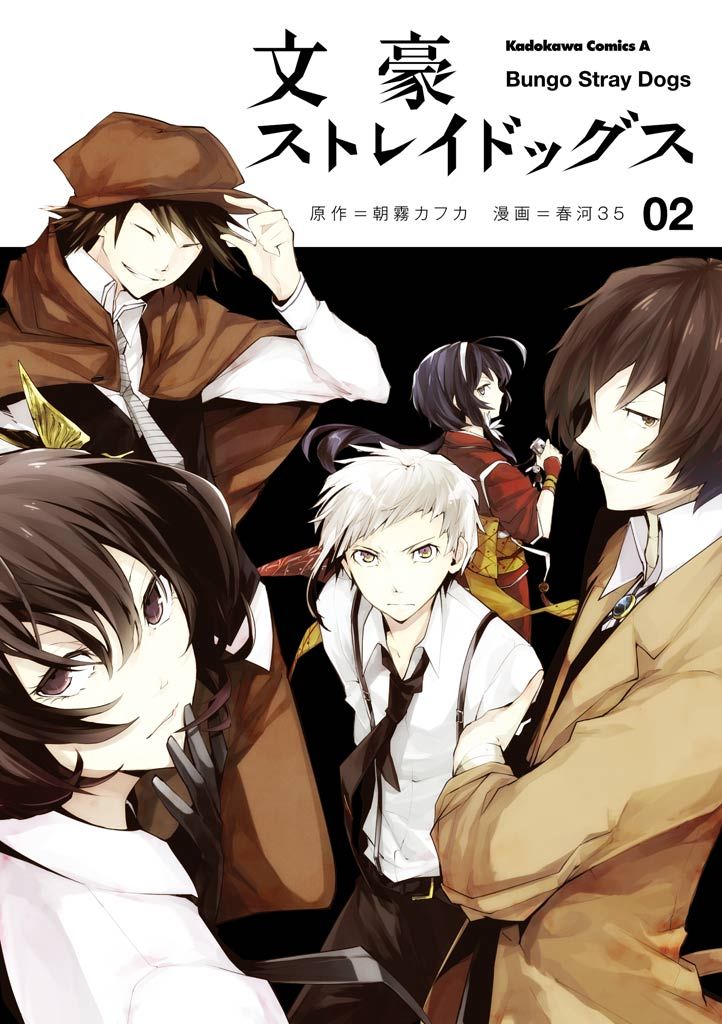
Cover of Bungo Stray Dogs volume two.
Bones studio’s Bungo Stray Dogs (lit. Literary Stray Dogs), a popular Japanese anime series which originally started airing in 2016, is making a big comeback with its third season this April (1). The otaku fandom is naturally excited; it has been almost a year since the series’ last movie adaptation, Bungo Stray Dogs: Dead Apple (2018), was released, and the adaptation, by introducing a bunch of new characters, excellent villains, and a fairly complex plot, only left us with much more questions than it answered.
Bungo Stray Dogs is based on the supernatural action manga of the same name that follows a group of skilled agents gifted with supernatural powers which they use to solve mysteries, fight Yokohama’s underground mafia, and occasionally blast a building or two into the sky.
But apart from the crowd that is regularly engaged with Japanese animation, Bungo Stray Dogs has a lot to offer to audiences that are not that well versed in Japanese anime and manga culture. Above all, it offers them a crash course in Japanese, American, and Russian literature.
Written by Kafka Asagiri and illustrated by Sango Harukawa for Young Ace magazine in 2012 (1), Bungo Stray Dogs is probably best known for basing its characters on famous writers and their books, such as Osamu Dazai, Ryunosuke Akutagawa, E. A. Poe, F. Scott Fitzgerald, and F. M. Dostoevsky. While each Bungo character represents a particular writer, their supernatural power is in one way or another connected to that writer’s works.
This way, for instance, Bungo Stray Dogs’ Osamu Dazai (all characters are actually called the same way as the writer they’re were based on), one of the series’ central figures, was inspired by the early 20th-century Japanese writer Osamu Dazai, author of The Setting Sun (1947) and No Longer Human (1948). The writer had a short but turbulent life: he lived during the two world wars, experienced a series of more or less serious diseases, wrote a number of novels and short stories whose popularity quickly turned him into a celebrity and attracted a secret admirer, regularly enjoyed way more sake than is advisable, and attempted to commit suicide several times until he finally succeeded in doing so in 1948, together with his wife Tomie Yamazaki. Inspired by these elements from Dazai’s life, Bungo’s Dazai is, as a result, constantly preying for a partner to commit a double suicide with, and his special ability, which allows him to cancel other ability-users’ power, is called “No Longer Human”, just like the ‘real-life’ Dazai’s famous novel.
Similarly, one of the series’ main antagonists, the Port Mafia member Ryunosuke Akutagawa, is based on the Japanese writer Ryunosuke Akutagawa, “Father of the Japanese Short Story”, whose famous works include Rashomon (1915), Hell Screen (1918), and In A Grove (1922). Many of Akutagawa’s stories are characterized by their macabre character. Rashomon, for example, is a story about an encounter between a servant and an old woman at the southern gate of Kyoto, where corpses were sometimes dumped. Hell Screen recounts the life of the painter Yoshihide who looses his mind in the process of creating a folding screen depicting the Buddhist hell. Akutagawa’s macabre aesthetic is also one of the main features of Bungo’s antagonist Akutagawa: the sickly, pale-skinned member of the mafia is always wearing dark clothes with a slight aristocratic touch and his ability, “Rashomon”, allows him to summon a phantom-like creature from his coat.
The same character-modeling principle (i.e., developing characters based on famous writers and their works), applies to the American and the Russian part of Bungo’s character repertoire. Bungo’s F. Scott Fitzgerald, a young millionaire and leader of the North American organization called The Guild, parades through the streets of Yokohama together with his fellows H. P. Lovecraft and Nathaniel Hawthorne just as the ‘real-life’ Fitzgerald’s Gatsby probably paraded through the streets of New York City during the Roaring Twenties. The Russians, Ivan Goncharov and A. S. Pushkin, are grouped together in an underground secret organization called Rats in the House of the Dead (the name is a reference to F. M. Dostoevsky’s novel The House of the Dead (1862)), led by the mastermind Fyodor Dostoevsky, whose ability is none other than “Crime and Punishment”, inspired by the Russian writer’s famous work.
All these different characters’ encounters on the streets of Yokohama, whose night scape is beautifully depicted in classically neon, cyberpunk tones, generate a unique atmosphere in which different cultures collide; E. A. Poe struggles to outwit his Japanese counterpart Edogawa Ranpo, while Herman Melville is gliding above them and the Yokohama skyline in Moby Dick, The Guild’s official aircraft (you can probably guess it’s in the shape of a whale).
But besides letting you pick up a few names from Japanese, American, or Russian literature, Bungo Stray Dogs has few more things to offer. The dynamic between the various literary-inspired characters creates original (although sometimes a bit complex, and sometimes a bit dark) plot lines. For example, while the initial plot line largely centers on Nakajima Atsushi, who was kicked out of an orphanage and has no food and no place to go but suddenly runs into Osamu Dazai and his partner Kunikiada who are tracking down a loose tiger that appeared in the area (the tiger later turns out to be Atsushi himself), the initial focus on Atsushi, who nevertheless remains one of the central figures of Bungo’s story world, gradually fragments into several plot lines which follow the Armed Detective Agency’s encounters with the Port Mafia, The Guild, and, later, the Rats of the House of the Dead. The perspective also frequently changes from that of the detective agency to a close-up view of the mafia’s business, which allows us to discover some elements of the characters’ dark past. Finally, although Bungo Stray Dogs is generally not a ‘dark’ anime (apart from some bloody visuals here and there), it does get pretty dark in Bungo Stray Dogs: Dead Apple with the introduction of the antagonists Tatsuhiko Shibusawa and Fyodor Dostoevsky as special ability users in Yokohama and all over the world suddenly start committing suicides.
All in all, even if anime and manga are not really your thing, but you do have an interest in literature and cross-cultural encounters of all kind, I would definitely recommend giving Bungo Stray Dogs a go. The series is pretty unique in the way it plays with cultural figures from different parts of the world and engages them into unexpected encounters on the streets of Yokohama. Its underlying literary theme gives the otherwise ‘yet-another-action-anime’ an original touch and might end up being just right for all the ‘less-anime-and-manga-inclined’ bookworms out there.
Sources:
1. Valdez, Nick. “Bungo Stray Dogs’ Season 3 Shares New Poster.” ComicBook.com, 1 January 2019, https://comicbook.com/anime/2019/01/01/bungo-stray-dogs-season-3-poster/. Accessed 9 February 2019.

The Good, the Bad and the Bloody
Every armchair expert on economics or the Middle East can be counted on to shout “it’s the oil!” when discussing why Saudi Arabia is what it is and does what it does. And when one looks at the headline figures, it is hard to argue otherwise: the Kingdom is the world’s largest oil exporter, has the second-largest reserves and is the de facto head of OPEC, a cartel of oil exporting countries. It is also the quintessential rags-to-riches oil state, defined by irresponsible spending, peculiar national priorities (what is the point of building a 1 km high tower?) and a bloated bureaucracy. Oil has long been the indicator Saudi Arabia’s foreign and domestic policy, but times might be changing.

Disclaimer: The contents and opinions of this blog post do not represent the views or values of Honours Review as a publication.
Every armchair expert on economics or the Middle East can be counted on to shout “it’s the oil!” when discussing why Saudi Arabia is what it is and does what it does. And when one looks at the headline figures, it is hard to argue otherwise: the Kingdom is the world’s largest oil exporter, has the second-largest reserves and is the de facto head of OPEC, a cartel of oil exporting countries. It is also the quintessential rags-to-riches oil state, defined by irresponsible spending, peculiar national priorities (what is the point of building a 1 km high tower?) and a bloated bureaucracy. Oil has long been the indicator Saudi Arabia’s foreign and domestic policy, but times might be changing.
America, Hell Yeah!
Saudi Arabia’s most important and long-lasting ally is none other than Uncle Sam. In 1945, Franklin D. Roosevelt and King Abdulaziz Ibn Saud met and stated they would “deal with the world’s problems”. Be it by supplying hundreds of millions of dollars’ worth of weapons to the Mujahideen to fight the Soviets, by invading Iraq, or by bombing the living daylights out of a vast number of civilians in Yemen, the two countries have always found a way to ‘solve’ the issue at hand.
For decades this rather ham-fisted approach to problem-solving was, if not accepted, at least recognized. However, the end of the Cold War and the rise of a multi-polar world has meant that the idea that the end justifies the means no longer holds water. America can no longer browbeat its allies into toeing the line, nor stop other great powers from speaking out. Furthermore, Saudi Arabia’s position has been further weakened by two major PR blunders the last 20-odd years.
The Middle East was barely a blip on the radar in the 1990s. With the exception of the Oslo Accords, the region was side-lined by the democratization of Eastern Europe, the Rwandan genocide and IRA terrorist activities in the UK. Then, on the 11th of September 2001, the Middle East, and especially Saudi Arabia, entered the global consciousness. With 15 of the 19 attackers coming from the Desert Kingdom, the al Saud family had some explaining to do. It was a historical low point in US-Saudi relations, and people everywhere started asking questions: Who funded the terrorists? Why is such virulent anti-Western preaching allowed in the country’s mosques? What can be done about it? None of these questions got satisfactory answers, and the bilateral relationship has never really recovered. Both countries lost international legitimacy – one because of its less-than-appealing reputation as a terrorist Petri dish, and the other for starting two rather ill-considered wars.
The Fresh Prince
In 2017, Mohammed bin Salman (MbS) became Saudi Arabia’s new crown prince. He wanted to stop the country’s reliance on oil, modernize its financial sector and temper the puritanical form of Islam with which his Kingdom has become synonymous. His plan, Vision 2030, was hugely ambitious: reduce debt, make the world’s largest oil company partially public, and eliminate corruption (so far all of them have seen little success). In the West, though, the most prominent reform involved civil society, such as allowing women to drive and reopening cinemas. MbS was hailed as a reformer, a breath of fresh air, a counterweight to the gerontocratic leadership of the Saudi state. And, for all intents and purposes, he was. Saudi Arabia is unquestionably on the path of reform and is barrelling along frighteningly fast.
With such far-reaching reforms, instability is inevitable. So is criticism. People are bound to disagree, either because the reforms go too far or because they don’t go far enough. Jamal Khashoggi fell in the second group. He objected to the Prince’s authoritarian tendencies and went into self-imposed exile to the US in order to ensure he did not fall victim to these exact tendencies. Unfortunately, he did. It was the biggest test of US-Saudi relations since 9/11, and wiped out all of the goodwill bin Salman had built up with his aforementioned reforms. It is not newsworthy that a Middle Eastern country kills journalists. What is newsworthy is when a journalist with American residency is allegedly cut into pieces and dissolved in acid. That’s behaviour you expect from drug cartels, not from a country trying to change its international reputation.
Beyond Oil, without America
Whether Khashoggi’s comments were justified or not is largely irrelevant. Saudi Arabia has to change its economy and would be wise to cultivate new relationships. Predictions differ, but thanks to electric vehicles, renewable energy and ever-increasing efficiency, oil consumption will plateau between 2030 and 2040, with oil prices likely dropping much earlier. Economic diversification isn’t preferable for Saudi Arabia, it’s necessary. With the world, and thereby America, becoming less reliant on oil, Saudi Arabia’s decades old and hugely powerful bargaining tool will slowly become less effective. Already now, America only imports a small fraction of oil from the Kingdom, but is keen to retain influence due to it’s geographically important location and its power over oil markets. This meant that Saudi Arabian political priorities could be predicted with relative certainty: maximize the value and stability of oil, and keep Washington happy.
The last few years have been different. In 2015, MbS became minister of defence and promptly started a war in Yemen at the request of the ousted Yemeni government. Three years, tens of thousands of deaths and a major humanitarian disaster later, end is not in sight. The Yemeni war is a pointless exercise in jingoism with little political or economic benefit compared to the horrific costs incurred. In 2017, Saudi Arabia and a number of other countries severed diplomatic relations with Qatar, ostensibly because the small country supported terrorist groups and its relatively good relationship with Iran, Saudi Arabia’s sworn enemy. Finally, there is the already-discussed vanishing act performed on Mr Khashoggi. None of these activities make sense when one looks at the historical reasons for Saudi Arabia to take action outside its own borders. For almost a century, Saudi politics was defined by a clever balancing act involving the appeasement of the country’s religious establishment and courting Western support, while using oil and its revenues to build and maintain influence wherever necessary.
More recently, though, Saudi policy has been dominated by bombs, bone saws and bellicose rhetoric, guided by impulsive reactions to personal insults instead of a considered approach based on politics and national well-being. As a consequence, traditional alliances have been strained and the desperately needed reforms struggle to gain steam. If that was not enough, MbS is eroding the al Saud family’s historical strength – its unity. Imprisoning relatives and changing the line of succession aren’t chapters one and two of How to Win Friends and Influence People. He has let ego cloud his judgement, putting the whole reform agenda at risk. That would be a disaster for millions of Saudis and for none more than bin Salman himself, whose political future hinges on the success of the reforms.