

Fragility, Pride, and Historical Legacies in Isao Takahata's "Grave of the Fireflies" (1988)
Directed and produced by Isao Takahata, Grave of the Fireflies (1988) is an animated movie telling a story of war, grief, and tragedy. During an attack on their village two children, Seita and Setsuko lose their mother. Their father is a soldier in the Japanese army, currently fighting in the Second World War, so the children decide to temporarily stay with their aunt. However, as time passes, the aunt begins to treat Seita and Setsuko as if they are unwanted intruders in her household. As a result of their relative's attitude and lack of compassion, the children proceed to run away and move in an abandoned bunker which they try to transform into a home. As the story unfolds, it portrays Seita and Setsuko's experiences while dealing with post-war reality – hunger, illnesses, and loneliness.
Disclaimer: The contents and opinions of this blog post do not represent the views or values of Honours Review as a publication.
Directed and produced by Isao Takahata, Grave of the Fireflies (1988) is an animated movie telling a story of war, grief, and tragedy. During an attack on their village two children, Seita and Setsuko lose their mother. Their father is a soldier in the Japanese army, currently fighting in the Second World War, so the children decide to temporarily stay with their aunt. However, as time passes, the aunt begins to treat Seita and Setsuko as if they are unwanted intruders in her household. As a result of their relative's attitude and lack of compassion, the children proceed to run away and move in an abandoned bunker which they try to transform into a home. As the story unfolds, it portrays Seita and Setsuko's experiences while dealing with post-war reality – hunger, illnesses, and loneliness.
Many analyses focus solely on the literal historical aspects of Takahata’s film, however, I believe that for a substantial reading of the story it is crucial to consider the symbolism incorporated into it. Multiple elements included in the movie carry figurative meanings that ought to be acknowledged in order to precisely grasp the essence of the movie. For the purposes of this text, I have selected three notably prominent motives: the notion of fragility, patriotism and historical legacies, and the motive of pride. Nevertheless, it is necessary to also include a disclaimer at this point in the text – this paper is written with complete awareness that the film features multiple more distinct themes that could potentially alter interpretations discussed in further parts of the text.
Fragility
The notion of fragility is one of the most pronounced themes present in Takahata’s Grave of the Fireflies, and the title itself is already a suggestion of possible interpretations and readings. As stated by Mario Vargas Llosa, “though we virtually take it for granted, the title (...) is often one of the first clues to the quality and direction of the reader’s conceptual involvement and properly should be considered integral to the frame of the work.”. Although in this statement Llosa is referring to titles of novels, I find it equally applicable in the field of film analysis. In the case of Takahata’s movie, overlooking the meaning of the title and its implications for the analysis would most likely result in degradation of the whole interpretation. To further explore this notion in a clear manner, it is vital to provide a brief explanation of the plot of fragments of Grave of the Fireflies. At the very beginning of the movie, two main characters are introduced. Seita and Setsuko, or rather their ghosts, come out of a can that is laying next to Seita’s body. They are accompanied by a swarm of fireflies. Multiple times throughout the movie, the fireflies are described as beautiful but fragile creatures; they are one of the very few beautiful things in Seita and Setsuko’s life which mostly consists of trying to escape the war and its consequences. Following this thought, as well as taking into consideration the plot of the whole movie, one can assume that the titular fireflies refer to the main characters and their struggles in Japan torn by war. Similarly to the insects, the children are fragile and cannot endure the difficulties that they have to face in their everyday fight for survival. They metaphorically light up with appropriate for their age optimism and hope for the future, and they try to fend for themselves; however, it does not last long, as the lifespan of a firefly is very short. Alike the literal light of a firefly, the figurative light glows in the children intensely yet briefly - the reality breaks Seita and Setsuko’s spirits and it weakens them physically. At some point in the movie, Setsuko asks her brother “Why do fireflies have to die so soon?” but her question is left without an answer.
Pride
Although it is not as prominently and obviously its component as the notion fragility, another important element in Grave of the Fireflies that is significant for a clear understanding of the movie is the concept of pride. This particular notion is present in various forms within the movie. First of all, pride is a sort of a catalyst for Seita to take care of his sister by himself after their mother died. Their father is in the army and Seita gets into an argument with a relative they stay with for a short time so the children end up homeless and on their own. As an older brother’s duty, Seita has to protect and take care of his little sister. He genuinely does his best to find shelter and get food for himself and Setsuko. In his efforts, he even starts stealing and he gets badly beaten up, though in front of his little sister he puts on a mask and convinces her that everything is fine. However, as time goes by and Seita does not succeed in providing food enough for both of them, Setsuko becomes malnourished and sick, and as a result, she passes away. As much as Seita tried to take care of his sister, it was his pride that firstly became the reason why they left their relative’s house. It was also pride that stopped the boy from getting real help when Setsuko got sick; instead, he claimed that as the older brother who should be able to look after his younger sibling he had the situation under control. Nevertheless, it is not clear if Seita really believed so, or it was only wishful thinking that he maintained as a coping mechanism to deal with the position the children were unable to escape.
Historical legacies
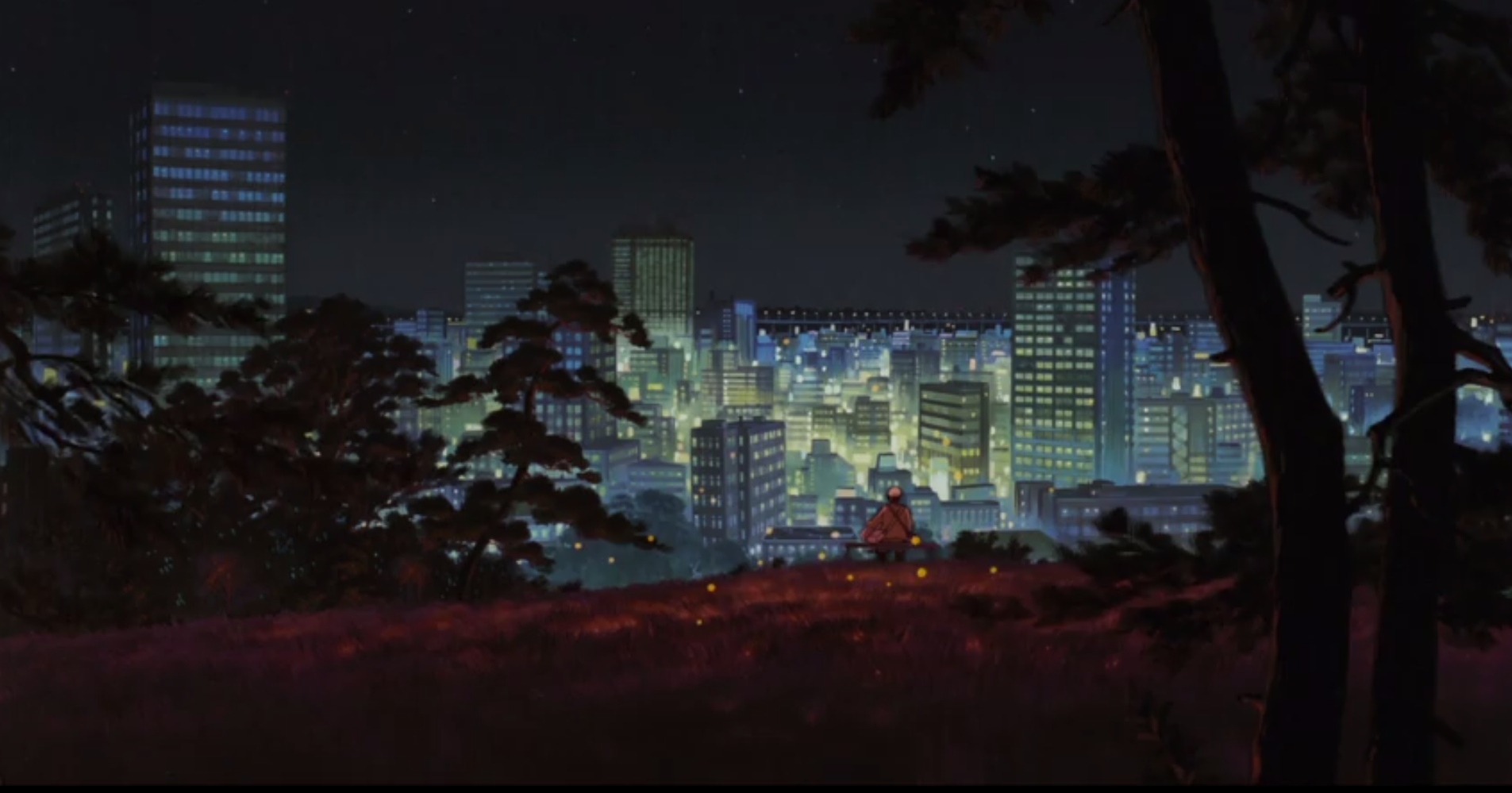
The ending scene of Grave of the Fireflies presents the third theme mentioned in the introduction which is the notion of historical legacies. Since the movie is inspired by real events that took place during the Second World War, the themes of patriotism, obligations to the state and to the society, fight for the common good, etc. are very present throughout the whole movie. However, for the sake of this article would like to focus on the ending sequence and its meaning in terms of the notion of historical legacies. In the last shot of the film, Seita and Setsuko’s ghosts can be seen peacefully sitting together on a bench on top of a hill. So far the story took place in what looked like a rather rural area of Japan - mostly small villages and fields. In this case, the setting seems to have changed quite profoundly. As Seita and Setsuko look down from the hill, the landscape on the other side appears in front of them. However, instead of seeing simple countryside scenery, it is a large city that emerges before the siblings. I find this particular scene especially relevant in the discussion about historical remembrance. The urban landscape rises on top of buildings destroyed by war, both literally and figuratively. It signifies the need to keep in mind the historical foundations that contemporary Japan is built on, but this message does not apply only to Japan. It can be seen as a suggestion for all viewers who grew up in countries that experienced military conflicts in the past to remember and respect the history of their countries because in many cases it was the ancestors’ fight for freedom, their resistance, and sacrifices that allowed for the construction of a stronger society. However, at the same time, it is also a reminder that many innocent people such as children like Setsuko and Seita lost their lives, which is undeniably a significant element of the notion of historical legacies.
Final thoughts
Being a depiction of a tragic story of two children trying to survive in a country torn by war, Isao Takahata’s Grave of the Fireflies is an example of a movie that portrays the notions of fragility, pride, and historical legacies as universal themes. Although this article offers multiple starting points for discussions regarding these topics, the three aforementioned motives are only some of many more possible perspectives that can be considered while interpreting this movie. I believe that it is crucial not only to take into account literal meanings of the symbolic elements incorporated in the movie, but also to consider their figurative, more universal significance of the components examined in this text.
References
Rossman, Charles, and Alan Friedman. Mario Vargas Llosa: A Collection of Critical Essays. University of Texas Press, 1978.
Takahata, Isao. Grave of the Fireflies. Studio Ghibli, 1988.
Additional materials:
Interview with Isao Takahata: https://www.youtube.com/watch?v=uRl0sjwx5Ac.
A short story by Akuyuki Nosaka: Nosaka, Akiyuki. "A Grave of Fireflies." Japan Quarterly 25.4 (1978): 445.

Trailer Music–The First Music Impression: Between Art And Commerce (Part 2)
It is known how to make a good trailer tune; it is also known that it is not a simple challenge. From the beginning of trailer-making, the practice of reusing music used for other trailers has flourished–after all, once an appropriate sound is found, it is tempting to use its qualities and maybe even the popularity it acquired through the movie that used it before. Classical music such as Carmina Burana or Lux Aeterna has been overused to the point it is hardly ever brought up anymore; so did pop songs like Walkin’ on Sunshine.

Disclaimer: The contents and opinions of this blog post do not represent the views or values of Honours Review as a publication.
Qualities of a Prototypical Trailer Theme

Source: Wright, Jonathan. “Tips for Composing Trailer Music”. Jonathan Wright Music, 2016. http://www.jonathanwrightmusic.com/composing-trailer-music/. Accessed: 03.06.2018.
Tips and masterclasses on trailer composing can be found online–choosing and creating music for film previews has grown multiple tendencies, preferred structures and even downright clichés seen in the statistics. A typical trailer released between 2014 and 2017 would contain a cover of a pop/rock song originally released in the 60s or 70s in a somber mood (7); since 2017 over six major trailers (Assassin’s Creed, Power Rangers, Atomic Blonde, etc.) featured a song by Kanye West (8); Suicide Squad and Guardians of the Galaxy proved that marketing of a movie can work mainly around the incorporation of popular music in the trailers. If the music is to be composed for the trailer, it will usually start with a brief intro presenting the theme, followed by a build-up, intense, blasting climax, a sudden full stop, and a quiet outro (9). Fanfares and huge orchestral arrangements (preferably with choirs) are perfect for the culmination. Slight changes in mood followed by a return to the main theme can be a good idea, as it can both provide variety and response at hearing the known tune repeated. In between, sound design effects will be included for the purpose of intensifying the cuts and action (boom, hit, drop, whoosh) or suspense (braam, riser, drone) (9). The purpose always kept in mind is to make an audience remember the trailer even a few days after they saw it: letting them recognize their favorite songs can be just as good of a strategy for it as creating an epic or deeply terrifying atmosphere.
Reuse–Advantage or Drawback?
It is known how to make a good trailer tune; it is also known that it is not a simple challenge. From the beginning of trailer-making, the practice of reusing music used for other trailers has flourished–after all, once an appropriate sound is found, it is tempting to use its qualities and maybe even the popularity it acquired through the movie that used it before. Classical music such as Carmina Burana or Lux Aeterna has been overused to the point it is hardly ever brought up anymore; so did pop songs like Walkin’ on Sunshine. When professional trailer music-making bands and composers saw the opportunity, they began to create albums full of music ready to use for trailers (once again, Two Steps from Hell is a perfect example), and soon enough their different musical pieces (already quite similar to each other sound-wise) became part of the canon of constantly reused trailer soundtracks.
On the one hand, not that many people watch enough movie trailers to be bothered by the trends of overuse. Most of the time, it is the visuals and reveal of the narrative present in the trailer that are discussed, rather than music (unless the sound is either exceptionally good or really bad). These tunes are not meant to be original–they are just supposed to hook the audience onto the action, intensify the visuals and leave a lasting first impression–and they are capable of doing exactly that even if it is their fifth or twentieth time of reuse. Trailer music, as instrumental or mood-driven can easily fit many narratives without seeming out of place. At the same time, though, critics and more knowledgeable audiences are increasingly bothered by the trends of utter commercialization of music in movie trailers. Since 2015 YouTube videos and general articles focused more on pointing out these practices of overuse. Eventually, the news has the potential to spread enough to reach even the less interested audiences who might have enjoyed trailers without noticing how cheap their music production is but now can become aware and critical. Recognizing music from another trailer in a new one can not only lead to the critique of commerce, but it can also remind the viewer of another trailer/franchise they heard the song in. This, in turn, can lead them to compare the two, which is a danger if the trailer for the new movie is not better than the old one (10).
Conclusion
Trailer music, like every other domain of art, has its clichés and commodified ideas on how to make a good first impression. However, unlike many art disciplines and unlike film music, it is far less bothered by it, due to the fact it lies in the domain of marketing. As a result, audiences who pay attention to the sound and value artistic qualities may have their hype for a movie damaged by the cheap production of trailer music. Others, however, stay unbothered–so if the marketing corporations manage to avoid overusing a song after it surpasses a point of its bad fame spreading, they can still practice reuse safely. At the end of the day, trailers are fleeting and it is the movie that matters far more; the previews and their music serve a mere pragmatic function, which can be executed more easily when known successful structures are used.
Bibliography:
Trailer Park. “About”. Trailer Park Official Website, 2018. https://www.trailerpark.com/about. Accessed: 3 June 2018.
Kelly, Stephen. “Movie trailer music: it's not what you think”. The Guardian, 2011. https://www.theguardian.com/film/2011/aug/25/movie-trailer-music. Accessed: 3 June 2018.
Ward, Caleb. “How to Pick the Right Tone, Shots, and Music for Trailers”. The Beat, 2015. https://www.premiumbeat.com/blog/how-to-pick-the-right-tone-shots-and-music-for-trailers/. Accessed: 3 June 2018.
John Beal. “Credits”. Composer John Beal, 2018. http://composerjohnbeal.com/credits/. Accessed: 3 June 2018.
Barrera, Sandra. “Trailer score heroes: Two Steps from Hell brings its epic orchestra scores to the Walt Disney Concert Hall”. Daily News, 2013. https://www.dailynews.com/2013/06/07/trailer-score-heroes-two-steps-from-hell-brings-its-epic-orchestra-scores-to-the-walt-disney-concert-hall/. Accessed: 3 June 2018.
Boltanski Luc andThévenot, Laurent.On Justification: Economies of Worth.Translated by: Catherine Porter. Princeton University Press, 2006.
Gruttadaro, Andrew. “How to Choose the Right Cover Song for a Movie Trailer”. The Ringer, 2017. https://www.theringer.com/2017/7/27/16078190/how-to-choose-the-right-cover-song-for-a-movie-trailer-f1674c5011c4. Accessed: 3 June 2018.
Heritage, Stuart. “Harder? Better? Faster? Stronger? Why is every trailer soundtracked by Kanye?” The Guardian, 2017. https://www.theguardian.com/music/2017/may/26/kanye-west-trailer-soundtracks-netflix-ozark. Accessed: 3 June 2018.
Yajima, Austin K. “Trailer Music Terminology: Explained Easy!” Trailer Music Academy, 2017. https://www.trailermusicacademy.com/trailer-music-terminology-explained-easy/. Accessed: 3 June 2018.
DanFanMac. “Overused Trailer Music: 4 Reasons You Should Never Use a Song More Than Once”. Fuzzy Elevator Trailer House, 2015. https://fuzzyelevatortrailerhouse.wordpress.com/2015/08/14/overused-trailer-music-4-reasons-you-should-never-use-a-song-more-then-once/. Accessed: 3 June 2018.